
avel Nedved never won the Champions League. He never lifted the World Cup. Yet when Juventus fans debate the greatest foreign player to wear the bianconeri shirt, his name almost always surfaces before the likes of Platini or Del Piero. That contradiction—a career defined by relentless effort rather than silverware abundance—captures what made Nedved singular. The Czech midfielder played with a fury that bordered on self-destruction, as if every match were a personal referendum on his worth.I first watched him closely during Euro 96 in England. A 23-year-old with that unmistakable blond mane。running at defenders with complete disregard for his own safety. Czechoslovakia had split three years earlier, and the Czech Republic arrived as debutants. Nedved’s goal against Italy in the group stage—a left-footed drive from outside the box—signaled something raw and unfinished. By the final against Germany, he was everywhere: tracking back, surging forward, demanding the ball when teammates wilted. The Czechs lost 2-1 to Oliver Bierholt’s golden goal, but Nedved’s reputation as a big-game player was set. Four years later at Euro 2000, he ran the show against France in a group match, though the Czechs still exited early. These tournament performances, more than any club season, revealed his essential quality: he elevated his game precisely when the stakes were highest.Between 2001 and 2009 at Juventus, Nedved became something close to a footballing deity in Turin. The 2003 Champions League semi-final against Real Madrid remains his masterpiece. With Juventus trailing 2-1 from the first leg。
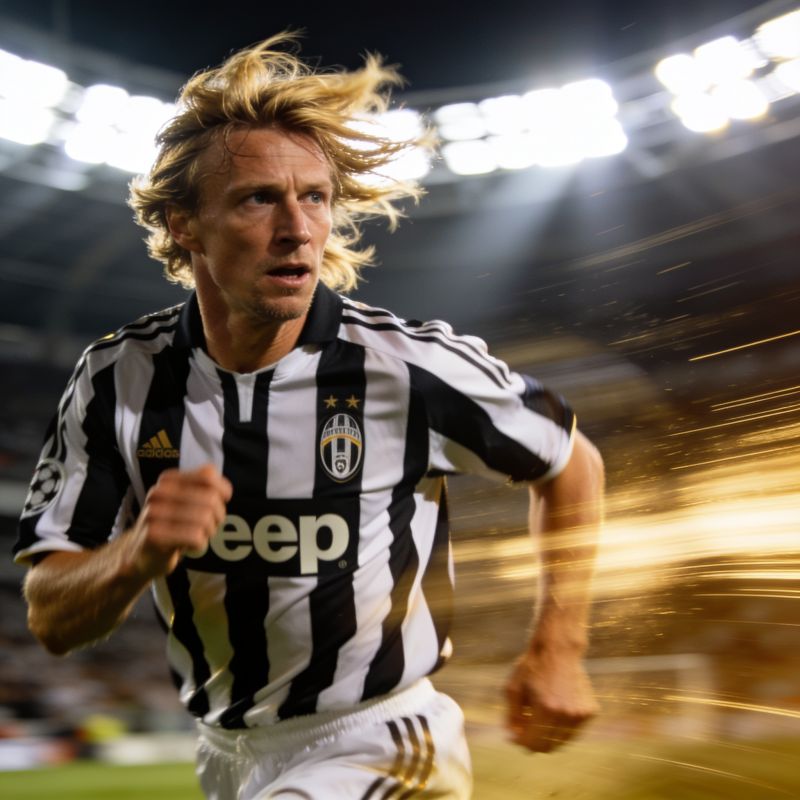
Nedved scored the opener at the Delle Alpi, then spent the rest of the night terrorizing Michel Salgado. His goal was typical of the man: a low shot through a crowd of legs, struck with no backlift. Juventus won 3-1 and reached the final. But a yellow card in that match—a needless tackle on Steve McManaman—suspended him for the final against Milan. He watched from the stands as Juventus lost on penalties. That image of Nedved, tears streaming down his face in the stands at Old Trafford, became emblematic of his career’s cruel margins. No player of his generation deserved a Champions League final more. He never got another chance.Losing the 2003 final didn’t break him. Two years later, he was instrumental as Juventus reached the 2005 final, only to lose to Liverpool on penalties—again without Nedved, who was substituted due to injury. The Calciopoli scandal in 2006 relegated Juventus to Serie B. Many stars fled. Nedved stayed. He was 34, well past his prime, yet he chose loyalty over easy medals. That season in the second division, he played 33 league games。scoring 11 goals. I remember watching grainy streams of Juventus away matches at small provincial grounds—Nedved, now a veteran with creaking knees, still chasing lost causes in the 90th minute. That decision, more than any trophy, defines his legacy. He wasn’t just a great player;he was a principled one. When he finally retired in 2009, Juventus had returned to Serie A. He left the club in a position to rebuild, having sacrificed his final years for a cause bigger than himself.What does Nedved mean to Czech football?He is the second of three Ballon d’Or winners from a nation of ten million—following Masopust in 1962, preceding Cech’s near-miss. But unlike Masopust, Nedved carried a struggling national team for a decade. At Euro 2004, he dragged the Czechs to the semi-finals, only to lose to Greece on the silver goal. His international career ended with 91 caps and 18 goals—modest numbers for a player of his caliber. Yet ask any Czech supporter over 30 about Nedved, and you’ll get the same response: a slight smile, a shake of the head, and the word “bojovník”—fighter. He wasn’t elegant like Zidane or prolific like Shevchenko. He was something more human: a player who made the most of every ounce of talent。who ran until his lungs burned, who treated every match as a battle. That’s why “nedved” still means something in football conversations. Not just a surname, but a standard of effort.