
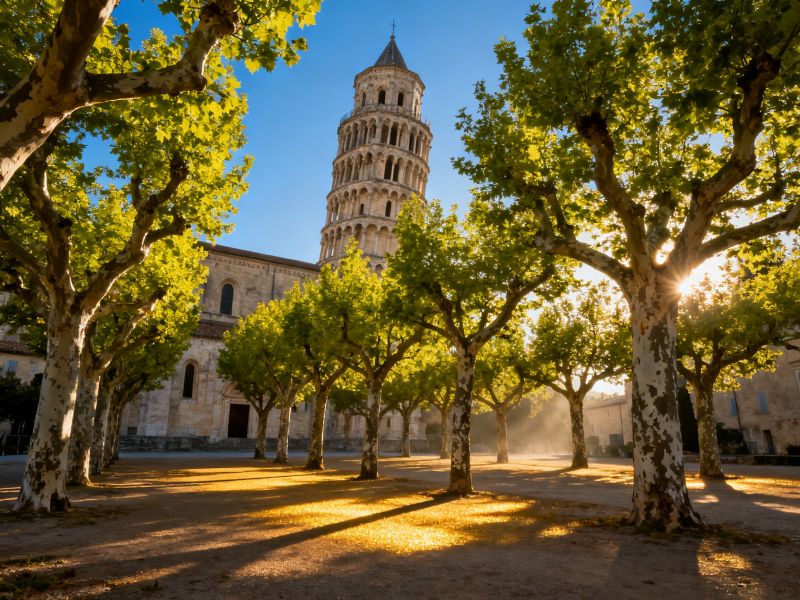
Digne-les-Bains doesn't announce itself. You arrive on theD900 from the south, past lavender fields that have gone gray by September, and the town sort of unfolds—a few blocks of shuttered shops, a thermal bath complex that looks more municipal than luxurious, then the wide allée des Siècles with its plane trees. I spent three days there last spring, and what struck me wasn't any single monument, but how Digne carries its history without performing it. The Digne of the guidebooks is a gateway to the Gorges du Verdon, a pit stop. The Digne I found is a working Alpine town of 16,000 that happens to sit on a Roman road and under a 19th-century cathedral tower that leans about 1.5 degrees。like a slow shrug.The bishopric is the reason Digne matters historically. From the 6th century until the Revolution, the bishops of Digne held both spiritual and temporal power—they minted coins, collected tolls, and basically ran the place. You can still see the evidence: the 13th-century Saint-Jérôme cathedral, rebuilt in the 15th and 19th centuries, sits tight against the slope of the hill. Inside, there's a retable by Nicolas Froment, and a crypt that smells of cold stone and candle wax. I stood there for ten minutes alone. That's the thing about Digne—it's not on the Riviera circuit, so the cathedral's custodian reads a novel at the welcome desk and lets you wander. The Digne bishopric archives, now municipal。hold documents that trace land disputes back to 1100. For a town this size, that's an unusually dense paper trail.Alexandra David-Néel put Digne on the map for a different kind of traveler. The explorer and mystic, who snuck into Lhasa in 1924 disguised as a beggar。
retired here and died in 1969 at age 100. Her house, Samten Dzong, is a short walk uphill from the thermal baths. It's a strange, wonderful place—Tibetan thangkas on the walls, a meditation room, her walking sticks leaning in a corner. The volunteer who showed me around mentioned that David-Néel used to receive the local postman for tea and lecture him on Buddhism. That detail stayed with me more than any statue. Digne honors her, but not too loudly. A street bears her name. The museum is open four afternoons a week, and the garden is overgrown in that deliberate-wild way the French do so well.The thermal baths themselves are worth a mention。though not for luxury. Digne-les-Bains has been a spa town since the Romans, and the current establishment—a 1980s concrete block with a glass atrium—treats rheumatism and respiratory complaints with water that comes out of the ground at 40°C. I took a morning soak. The clientele was mostly retirees from Marseille and Grenoble, covered in sulfur-smelling mud, talking about their knees. No one was Instagramming. It felt like a public service, which it partly is—the town subsidizes sessions for residents. That's the Digne approach: practical, unglamorous, quietly effective.
What I keep thinking about。though, is the landscape. Digne sits at the edge of the Géoparc de Haute-Provence, a UNESCO site where the geology is so exposed you can read 300 million years of history in a roadside cliff. I hiked the 6 km sentier des ammonites one afternoon. The path winds past blocks of black limestone studded with fossilized ammonites the size of dinner plates. A local teacher was there with a class of eight-year-olds, and they were arguing about whether one fossil was a snail or a squid. The Digne of that moment wasn't a bishopric or a spa or a literary footnote. It was a town where the ground itself is a textbook, and the schoolchildren know it. That's a specific kind of wealth. More towns could use it.